

How to Build a Magnetic Knife Holder with Neodymium Magnets
Build your own magnetic knife block and organize your kitchen in style! | ( Last Updated: 09/15/2026 )
Building a wooden magnetic knife holder using powerful neodymium magnets is a popular project. In this step-by-step guide, learn how to build a DIY magnetic knife strip using simple construction methods, how to pick the right knife magnets, explore the technical details behind magnetic holding power and more!
In this article we will cover the following topics:
Shop Neodymium Magnets
A DIY wooden magnetic knife holder provides a safe and convenient knife storage solution for kitchen knives while protecting their cutting edges. Unlike traditional knife blocks, magnetic knife holders allow quick access to chef knives, paring knives, bread knives, steak knives, and other kitchen cutlery without forcing the knife blades into narrow slots. Strong neodymium magnets firmly hold knives and other kitchen utensils in place, keeping countertops organized and frequently used knives readily available.
1. Gather tools and materials needed to build magnetic knife holder
Tools
- Saw - Prepare a table saw or miter saw/chop saw to make the main cuts in the wood.
- Router - Used for rounding or patterning edges.
- Drill - For easily driving in screws and drilling pilot holes.
Materials
- Wood - Choose wood type to your liking based on color, grain, etc. and a size large enough for your knife storage needs.
- Magnets - Disc or block magnets based on your design. Use the chart below or refer to our Knife Holder Magnets category page to quickly find a certain size.
- Adhesive - Some type of glue, adhesive or epoxy for securing the magnets to the wood.
- Screws - Enough screws to secure pieces of wood together
2. Step by step build guide for wooden magnetic knife holder
Cut the Wood
Cut a block of flat wood to size. Our knife block is 2" tall & 16" wide, from 3/4" thick cherry wood.

Create a Jig
Create a fixture for cutting a groove into the back of the wood in a nice, straight line. The groove is where the magnets will be installed. The shape and size of the magnets you are using will determine the dimensions of the groove.

Cut the Groove
Use a router to cut the groove in the wood. Set the depth properly to leave the desired thickness of wood that will be between the magnets and the knives. We left a 1/16" thickness of remaining wood (gap).

Finish the Edges
All major cuts on the wood are finished. A rounded edge all around was made with a router. You can also use the router to make other patterned edges.

Install the Magnets
We used disc magnet D83.
In the groove cut by the router, place the magnets in a row, alternating the north and south poles. For example, the first magnet will have the north pole facing up, the magnet next to it will have the south pole facing up. Repeat alternating north / south poles until all the magnets are installed in the knife holder.
Alternating the poles increases the magnetic attraction to a steel surface.
The edges of the magnets will naturally attract in this orientation, and won’t repel each other. Use a steel sheet (a.k.a. baking pan) to help keep the magnets in place during assembly.


Glue the Magnets
Glue the magnets in place. While many different types of adhesives will work well, a silicone adhesive was used here.

Test the Knife Holder
The nearly finished magnetic knife holder, hung on the wall for testing. We still need to finish the wood and use nicer screws.
The nearly finished magnetic knife holder, hung on the wall for testing. We still need to finish the wood and use nicer screws.

Finish the Wood
The choice of how to finish the wood is up to you.
We chose mineral oil to preserve the wood's natural beauty. It is often recommended for cutting boards, which sounded very similar to us. Mineral oil may need occasional re-application, though our knife holder has withstood a few years of household use quite well.

Shop Neodymium Magnets for Other Applications
Selection of strong rare earth neodymium magnets perfect for organizing your home or office.


3. Common Mistakes When Building a Magnetic Knife Strip
-
Drilling Individual Holes for the Knife Magnets
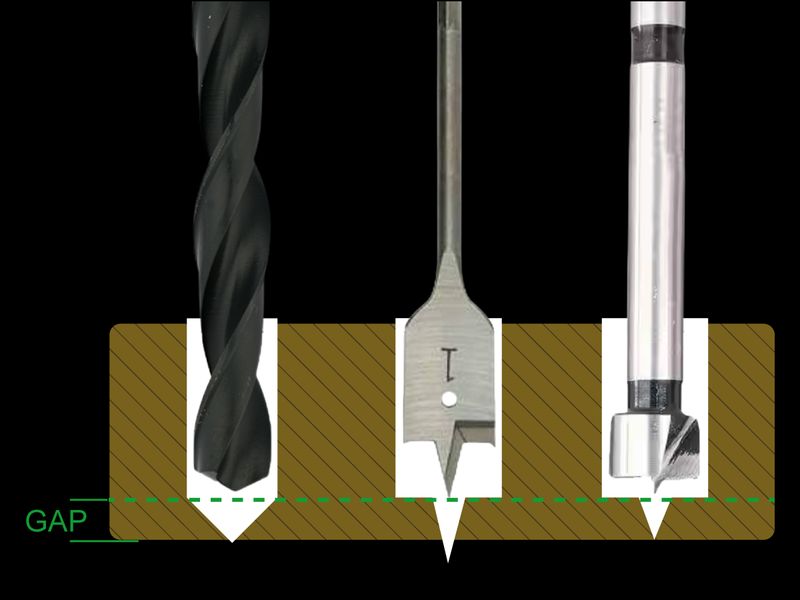
If drilling individual holes for your magnetic knife strip, make sure you use drill bits with the guide and shaft of the bit as close as possible to avoid drilling all the way through the wood, or creating a larger wood thickness gap than intended. With thin wood thickness gaps, wood boring bits and forstner bits will likely bore through the front of the magnetic knife strip. If you choose to drill individual holes, it's best to install the next larger size magnet thickness to compensate for the angled area space left by the drill bit.
-
Staggering or Spreading Out the Knife Magnets
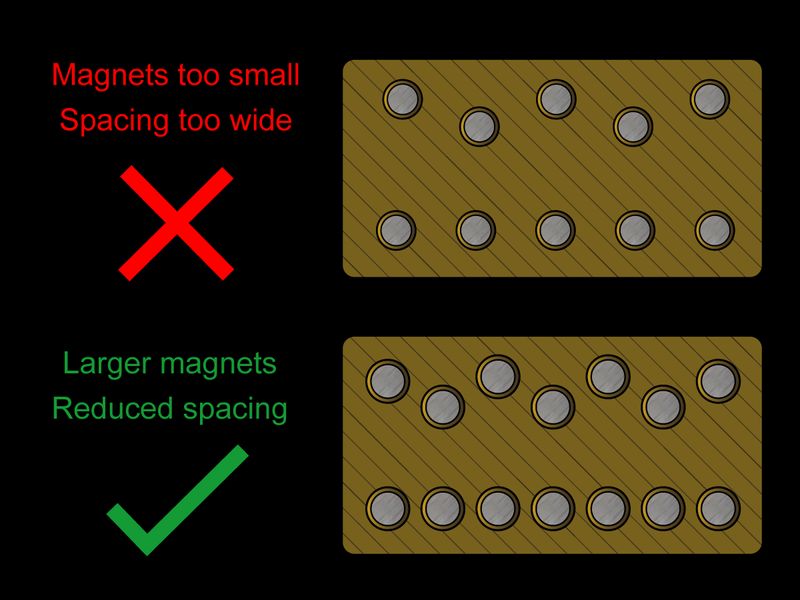
If you choose to stagger the knife magnets or spread them out as illustrated in the image below, these patterns are perfectly fine, but you lose the added strength of the north south magnetic array. Our DIY knife holder uses an array to get an increase in total magnetic pull force. If you are staggering or spreading the magnets out in your magnetic knife holder design, it is recommended to increase the size of the knife magnets to next size up and or reduce the spacing between the holes as a starting point for your design.


Best knife block magnets for most common wood thicknesses
-
D83 Knife Block Disc Magnet
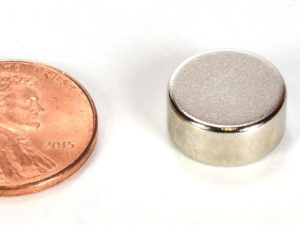
Best magnets for 1/16" (1.6mm) thick wood
Diameter: 1/2" (12.7mm) Thickness: 3/16" (4.8mm) Strength: 9.14lb (4.1kg)
Shop Now -
DA4 Knife Block Disc Magnet
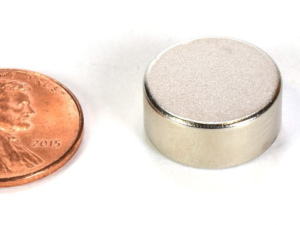
Best magnets for 1/8" (3.2mm) thick wood
Diameter: 5/8" (15.9mm) Thickness: 1/4" (6.4mm) Strength: 15.3lb (6.8kg)
Shop Now -
DF4 Knife Block Disc Magnet
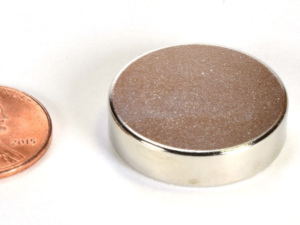
Best magnets for 1/4" (6.4mm) thick wood
Diameter: 15/16" (23.8mm) Thickness: 1/4" (6.4mm) Strength: 25lb (10.7kg)
Shop Now


4. How To Pick the Right Magnets for a Magnetic Knife Rack
Choosing the right magnets for your magnetic knife storage display depends on a number of factors:
- Gap: The thickness of the material between the magnets and the knife is the most important factor! Thicker material between the magnet and the knife means you will need bigger, stronger magnets to securely hold the knives.
- Knives: The size, shape and weight of the knives to be held (we planned for typical kitchen knives). The magnets you select must have enough pull force to vertically hold the weight of the knives through the thickness of your knife holder material.
- Magnets: The number of magnets used.
- Design: Whether you use a single row, multiple rows of magnets or individual magnets.
- Personal Preference: Experiment and test different magnets to find the magnets that work the best for your project. We experimented with a few different disc magnets – thinner D82 magnets, D83 and D84 magnets. D84 magnets worked, but the pull was too strong for us. We didn't want to have to pull too hard when removing a knife. We liked feel of the D83 magnets through our knife holder 1/16” wood thickness gap.

How Strong Should the Knife Magnets Be?
When selecting magnets for a magnetic knife holder, whether it’s a wall-mounted strip or a countertop block, the specific magnetic strength required depends on the thickness of the material that is between the magnets and the knife. The magnets should be strong enough to keep the knives securely in place without requiring excessive force to remove them.
Wood Thickness Effect on Magnets
The thickness of the wood (gap) that lies between the magnets and the knives is the most important factor in designing your magnetic kitchen knife holder. The magnets in your magnetic knife holder have to be strong enough to pull through the thickness of the wood to securely hold the knives in a vertical position. Thicker wood will create a wider gap that will reduce the holding strength of the magnets.
We've compiled the knife disc magnets and knife block magnets strengths per wood thickness charts below using our pull force calculator. The charts are a guideline and good starting point to find the right magnet for your magnetic knife display. The chart results do not include factoring in the friction force (see here for a simple way to estimate it). You can also refer to our Best Magnets for Magnetic Knife Blocks category page to quickly find magnets and filter results by common wood thickness gaps.
|
DISCS Part Number |
WOOD THICKNESS GAP | |||
|---|---|---|---|---|
| 1/16" Gap | 1/8" Gap | 3/16" Gap | 1/4" Gap | |
| DA2 | 2.64 lb | 1.30 lb | 0.71 lb | 0.41 lb |
| D83 | 2.67 lb | 1.24 lb | 0.64 lb | 0.36 lb |
| DB2 | 3.06 lb | 1.56 lb | 0.88 lb | 0.53 lb |
| D84 | 3.28 lb | 1.55 lb | 0.82 lb | 0.46 lb |
| D93 | 3.45 lb | 1.68 lb | 0.91 lb | 0.52 lb |
| DC2 | 3.49 lb | 1.84 lb | 1.06 lb | 0.65 lb |
| DF2 | 4.78 lb | 2.70 lb | 1.66 lb | 1.07 lb |
| DX02 | 5.20 lb | 2.99 lb | 1.87 lb | 1.22 lb |
| DA4 | 5.29 lb | 2.73 lb | 1.55 lb | 0.93 lb |
| DC3 | 5.77 lb | 3.11 lb | 1.83 lb | 1.14 lb |
| DB4 | 6.23 lb | 3.32 lb | 1.94 lb | 1.19 lb |
| D98 | 6.48 lb | 3.35 lb | 1.91 lb | 1.15 lb |
| DX42 | 7.42 lb | 4.53 lb | 2.98 lb | 2.04 lb |
| DE3 | 7.87 lb | 4.45 lb | 2.74 lb | 1.76 lb |
| DD4 | 8.27 lb | 4.65 lb | 2.84 lb | 1.82 lb |
| DA8 | 8.37 lb | 4.50 lb | 2.65 lb | 1.64 lb |
| DE4 | 9.42 lb | 5.41 lb | 3.37 lb | 2.20 lb |
| DC6 | 9.51 lb | 5.33 lb | 3.26 lb | 2.08 lb |
| DX03 | 9.61 lb | 5.65 lb | 3.59 lb | 2.38 lb |
| DB8 | 9.78 lb | 5.43 lb | 3.28 lb | 2.09 lb |
| DF4 | 10.65 lb | 6.24 lb | 3.96 lb | 2.62 lb |
| DC8 | 11.22 lb | 6.40 lb | 3.96 lb | 2.57 lb |
| DD8 | 13.52 lb | 7.90 lb | 4.99 lb | 3.29 lb |
| The colored areas of the chart show the best magnet strength starting point for each wood thickness gap. |
|
BLOCKS Part Number |
WOOD THICKNESS GAP | |||
|---|---|---|---|---|
| 1/16" Gap | 1/8" Gap | 3/16" Gap | 1/4" Gap | |
| BX442 | 2.68 lb | 1.33 lb | 0.73 lb | 0.42 lb |
| B666 | 2.84 lb | 1.29 lb | 0.65 lb | 0.36 lb |
| BC82 | 3.08 lb | 1.58 lb | 0.89 lb | 0.53 lb |
| BX062 | 3.08 lb | 1.58 lb | 0.89 lb | 0.53 lb |
| BC44 | 3.12 lb | 1.46 lb | 1.17 lb | 0.43 lb |
| B864 | 3.12 lb | 1.46 lb | 0.77 lb | 0.43 lb |
| BAA2 | 3.18 lb | 1.64 lb | 0.93 lb | 0.56 lb |
| BX043 | 3.47 lb | 1.69 lb | 0.91 lb | 0.52 lb |
| B883 | 3.48 lb | 1.69 lb | 0.92 lb | 0.53 lb |
| BX0C2 | 5.05 lb | 2.88 lb | 1.79 lb | 1.16 lb |
| BEE2 | 5.11 lb | 2.93 lb | 1.82 lb | 1.19 lb |
| BX444 | 5.37 lb | 2.78 lb | 1.58 lb | 0.95 lb |
| B886 | 5.62 lb | 2.86 lb | 1.61 lb | 0.96 lb |
| BX064 | 6.27 lb | 3.35 lb | 1.96 lb | 1.21 lb |
| BC84 | 6.27 lb | 3.35 lb | 1.96 lb | 1.21 lb |
| BC66 | 6.40 lb | 3.33 lb | 1.90 lb | 1.15 lb |
| BAA4 | 6.49 lb | 3.48 lb | 2.05 lb | 1.27 lb |
| B888 | 6.54 lb | 3.39 lb | 1.94 lb | 1.17 lb |
| BX8C2 | 6.95 lb | 4.20 lb | 2.73 lb | 1.85 lb |
| BX084 | 8.02 lb | 4.48 lb | 2.73 lb | 1.74 lb |
| BX8X02 | 8.67 lb | 5.43 lb | 3.65 lb | 2.54 lb |
| BX066 | 8.31 lb | 4.54 lb | 2.71 lb | 1.70 lb |
| BCC4 | 8.89 lb | 5.06 lb | 3.12 lb | 2.02 lb |
| BX484 | 9.75 lb | 5.63 lb | 3.53 lb | 2.31 lb |
| BC88 | 9.85 lb | 5.47 lb | 3.32 lb | 2.11 lb |
| BCA6 | 10.22 lb | 5.78 lb | 3.56 lb | 2.29 lb |
| BX0X03 | 11.11 lb | 6.75 lb | 4.41 lb | 3.00 lb |
| BX0C4 | 11.44 lb | 6.78 lb | 4.34 lb | 2.90 lb |
| BEE4 | 11.64 lb | 6.92 lb | 4.44 lb | 2.98 lb |
| BCC6 | 12.62 lb | 7.34 lb | 4.62 lb | 3.04 lb |
How To Securely Hold Knives to A Magnetic Knife Display: Estimate the Pull Force Needed
There is no set formula or calculator that will give you an exact size or strength of magnet that will work for your knives. Consider these three factors when choosing magnets for a magnetic knife holder:
- Gap: This is the thickness of wood (distance between magnet and knife blade). You can use our magnet pull force calculator to estimate the pull force case 1 you will get for any magnet with any thickness of wood. Helpful Tip:When using the pull force calculator, you would enter the wood thickness gap as the distance.
- Friction: This is how easily the knife will slide down and estimate of pull force lost. As a rough estimate of the friction force, you can assume about 10-20% of pull force case 1 will apply from the above pull force calculation. For a deeper dive into friction, check out our blog article How Much Will a Magnet Hold?
-
Magnet array: One or more rows of magnets with
alternating poles have a stronger attraction to a steel surface at smaller
distances (the space between the magnets and what they are attracting to).
It’s a version of a Halbach array and it’s what we used to make our DIY
magnetic knife holder. If you are interested in how Halbach Arrays work,
explore our blog post,
Halbach Arrays, for a closer look. It is possible to install the magnets in your
magnetic knife holder without alternating the poles. However, you may need
to use larger magnets, and there may be gaps in the magnetic field, which
could reduce the magnetic knife holder's overall performance.
Holding larger knives may require more than one row of magnets to stabilize the knife and to help prevent spin due to handle weight and position. How many rows of magnets would depend on variables including the size, shape and weight of the knives as well as design considerations such as the shape of the knife block, will it be wall mounted or free standing, etc.
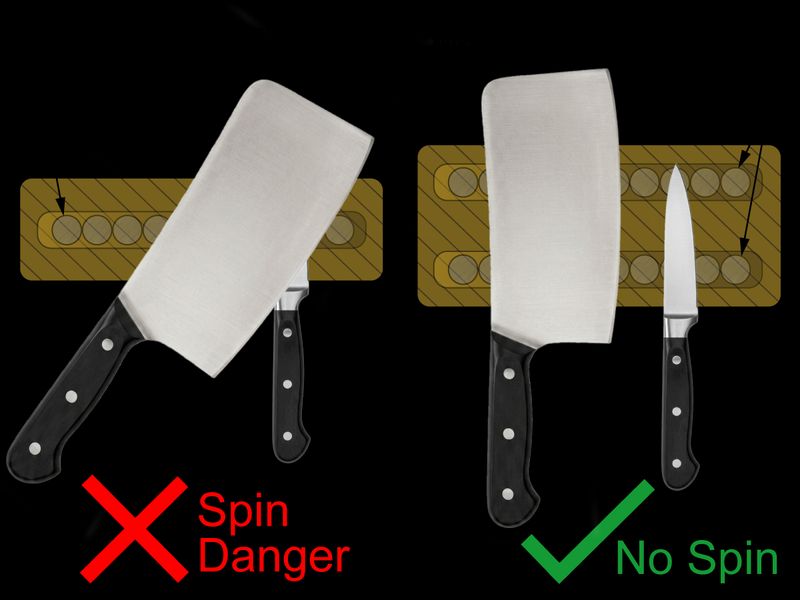

These estimates will provide you with a good starting point. Because magnetic holding performance depends on factors such as friction, knife material, knife size, wood thickness, and other design variables, we recommend experimenting with and testing different neodymium magnets to find the one that works the best for your wooden magnetic knife display.
Wooden Knife Holder Magnetic Field
This image is a picture showing what the magnetic fields would look like attracting to the knife in our magnetic knife holder. The poles are staggered to be north then south for increased pull force. The gap between the magnets and the knife represents the thickness of the wood.

5. Frequently Asked Questions
What if I want to use thicker wood for my magnetic knife strip?
Many folks email us about using thicker pieces of wood or having a thicker gap. You can certainly do this, but you'll need a much bigger magnet to get the same pull on the knife at the wood's surface due to a larger gap. If your wood thickness gap will be larger than 0.25 inches, refer to the How To Securely Hold Knives to A Magnetic Knife Display section of article for how to estimate the pull force needed.
What are the best woods for a magnetic kitchen knife display?
The best woods for a magnetic knife holder are dense, closed-grain hardwoods such as walnut, acacia, maple and cherry. Avoid open-grain porous woods like red oak and ash. The large pores can trap dirt and moisture, and over time, the wood is more prone to splintering or denting from heavy, frequent use.
What are the best magnets for a magnetic knife holder?
Neodymium magnets, also called rare earth magnets, are the best magnets to use in a DIY magnetic knife strip. Look for strong neodymium magnets that can firmly hold heavy kitchen knives and other kitchen cutlery through a variety of wood thicknesses and gaps.
Can a magnetic knife block damage knives?
The neodymium magnets aren't strong enough to warp the steel of the knife, but improper handling can cause scratching, chipping, and a dull edge. Opt for a wood magnetic knife holder as opposed to metal. Wood provides a forgiving surface that absorbs impacts and prevents scratches better than a metal magnetic knife rack.
Will all knives stick to a magnetic knife holder?
Not all knives will stick to a magnetic knife display. While most of the kitchen knives we've encountered are ferromagnetic (attracted to magnets), there are some types of stainless steel that are not magnetic. Ceramic knives will also not stick to magnetic knife holders. Test your favorite knife with a fridge magnet to see if the magnet sticks to the knife.
6. See the Completed Magnetic Knife Holder in Action
Below you can see what a completed magnetic knife holder may look like. Have you made your own version of a magnetic kitchen knife strip? If so, feel free to share it with us via email and we may even feature it in this very article!
Completed magnetic knife block
7. Knife Safety: How To Place and Remove Kitchen Knives on a Magnetic Knife Holder
First, make sure your magnetic knife holder is safe and inaccessible to children, but easy to reach when you need it. To safely handle knives on a magnetic knife holder, never pull or push the blade straight on or off the magnetic holder.
- To Place: For wall-mounted magnetic knife strips, position the knife so the handle points downward. For countertop magnetic knife blocks, position the knife so the handle points upward. Place the spine (the blunt, unsharpened top edge) flat against the wood. Gently tilt or roll the cutting edge toward the block until the magnetic pull grabs it. This ensures the sharp edge never scrapes directly against the block. In the video above, we placed the knives with the handle pointing downward.
- To Remove: Firmly grasp the handle and using the handle as a lever, slightly twist the cutting edge away from the magnetic knife holder. Roll the spine of the knife off the magnet until it releases.
8. Magnetic Kitchen Knife Organization: Other Design Ideas
- Construct a holder out of glass, acrylic or Lexan (polycarbonate). It might be cool to see the magnets!
- Many different methods of attaching the holder to the wall are possible, including with magnets!
- Multiple rows of smaller magnets could be used, instead of one row of single magnets. This can also help prevent spin if the rows are spaced out.
- Without the tools to cut a groove to a specific depth, a block could be constructed out of wood veneer. Use a thin piece of wood for the front surface, and glue the structure behind it.
- Some folks aren't interested in building a wood block, but still want to use neodymium magnets to hold their knives safe and clean. A simple, plastic coated disc magnet like our RX034DCSPC-BLK can make for a great, one-knife solution.


